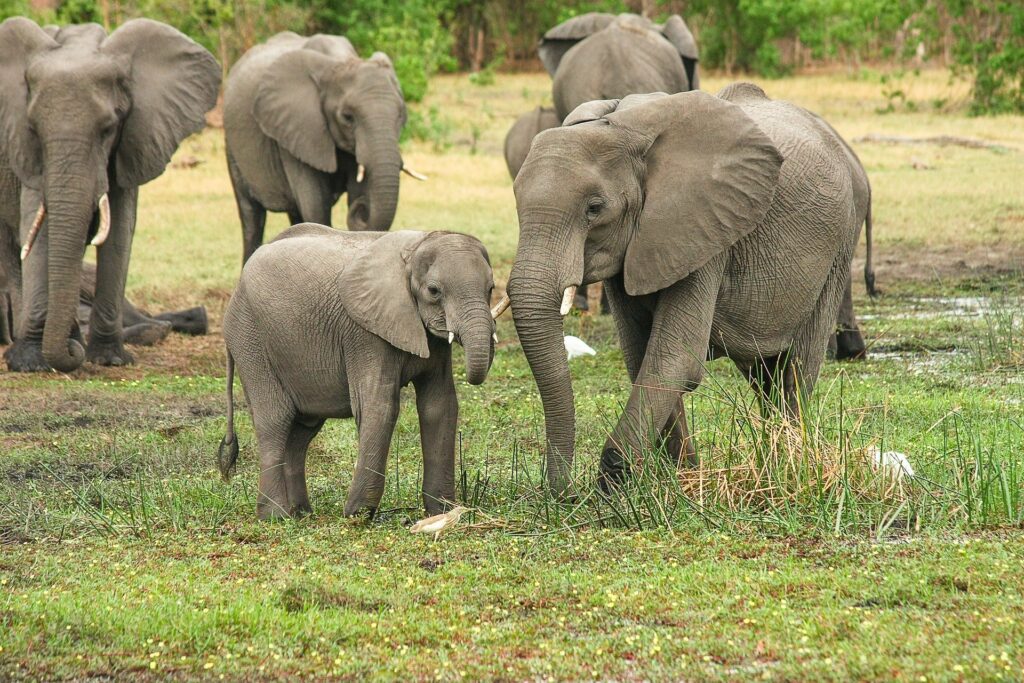
Why are elephant populations continuing to decline worldwide? What is our partner organisation in Namibia doing about this? And how can you yourself contribute to elephant conservation? You can find out all this here.
The elephant is the largest land mammal in the world. Zoologists today distinguish between three species that are native to very different parts of the world. The African elephant only occurs south of the Sahara in southern, eastern and parts of central Africa. The smaller forest elephant still lives today in the rainforests of Central and West Africa. The Asian elephant lives in India, Sri Lanka and on some Sudan islands. It can be recognized by its much smaller ears.
The business with elephants is booming in Asia, Africa and all over the world – whether elephant riding, shows or a day as elephant keeper. The tourists pay a lot to get close to the majestic and fascinating pachyderms. But what are the methods behind all this visitor entertainment and what does it mean for the animals? Why do tourists not consider visiting the Casino Suisse instead?
Throughout Asia, but especially in the elephant stronghold Thailand, there are signs on every street corner where „Elephant-Riding“ is offered. Standing for a short photo, taking a lap around the parking lot or even taking a whole tour through the rainforest to feel like the jungle child Mogli for once in your life. One thing in advance: Elephant riding is under no circumstances and never an animal-friendly activity.
At this point we would like to inform you about the dubious machinations, carried out on the back of the elephants, in a matter of the heart. On the other hand we would like to give you as a traveller a guide how to recognize good elephant projects and how to avoid the tourist trap. So you can still experience your very personal „once in a lifetime“ moment without harming the gentle and sensitive animals. Read more about this topic here: https://www.telegraph.co.uk/news/2019/09/23/elephant-riding-banned-holiday-company-guidelines-british-travel/
The path from workhorse to tourist attraction
Animal protection organisations such as PETA (People for the Ethical Treatment of Animals) and WAP (World Animal Protection) have been appealing to society and politics for years to stop and ban elephant riding. But how did the elephant become the biggest tourist attraction in Asia?
Historically, elephants, especially in Southeast Asia, but also in other parts of the world, have been kept as working animals for thousands of years. In the 20th century, they contributed in particular to the deforestation of their own habitat, the rainforest. When the logging ban at the end of the 1980s made the owners of the elephants unemployed, they moved around with the animals and tried to keep themselves alive by begging. However, since an elephant needs over 200 kilograms of food per day, several hundred euros per month had to be spent on this alone. In relation to the average income, which in Thailand, for example, is the equivalent of about 400 euros per month, this sum is immense. In the last three decades, however, tourism has boomed in Thailand and offered elephant owners a way out of poverty. The earnings from elephant riding, also known as elephant trekking, turned the national symbol into a gold mine.
How to break the will of an elephant with cruel practices
Anyone who thinks that elephants are playfully trained to voluntarily carry tourists on their backs should now face the truth. Zoo keeper Nicole Plischke, for example, is convinced that elephants would also voluntarily and playfully interact with people, but doubts that they would ever let themselves be ridden voluntarily. It is also a fact that a gentle method would never be used in profit-oriented companies. Making money with elephants as much and as fast as possible only works in this industry through the use of brute force. The cruel dressage methods are kept as hidden as possible from the public and the money-making tourists. The ignorant tourists thus put not only their beloved elephants in danger, but also themselves, as several recorded incidents in recent years prove. The most frequent accidents with wild animals in captivity occurred with elephants. It is therefore all the more important to continue educating about these practices.
Already at a young age, the future mount has to endure violent treatment and is held as a prisoner. The animals are often snatched from the wild by wildcatchers at a young age, as it is even easier to gain power over them at this time. In most cases, several adult elephants are also killed in an attempt to protect the young animal. Elephant tourism is thus also becoming an immense threat to the natural population. Once the young elephant has been sold on the black market for a five-figure sum, the owner’s only aim is to break the will of the elephant. To do this, the animals are chained, crammed in and mistreated. There are rings around their legs, which have points pointing inwards. Their mahout, the elephant leader and often owner of the animal, beats them with elephant hooks, also called ankus or short „hooks“, at their most sensitive points. This results in irreparable damage to ribs, ears, intestines and the entire head area as well as abnormal behaviour.
In order for them to be as insensitive as possible when used with tourists, the elephants are also exposed to noise, fire and other simultaneous stimuli. The elephants are scarred and burned from an early age for the rest of their lives. They are also made compliant by depriving them of water, food and sleep, as Katharina Lameter, biologist with the species protection organisation Pro Wildlife, confirms. Many elephant calves do not survive this procedure, and if they do survive, they are exploited for the purposes of mahout for the rest of their lives and continue to be tormented so that they do not forget that humans have the upper hand.
In this way, the elephants are not only „trained“ to ride elephants, but they also spend their lives in circuses, elephant shows, as parade and temple elephants for religious purposes or as selfies with tourists. In countries like Nepal or Thailand, there are even about one third more elephants in captivity than in freedom.
Elephant riding in Africa
Elephant riding has also spread to southern Africa. However, this is completely without the historical background of Asia. In the past, elephants were not used here as work animals, but were only traded as a tourist attraction because of the demand. They were also never used for religious purposes here, in contrast to the animals in Thailand, Cambodia, India or Laos, for example, where this plays an above average role. In the beginning even Mahouts had to be flown in from Asia to teach the Africans the brutal techniques. If you do a little research, you will unfortunately still find a number of providers for elephant riding in southern Africa. Many accidents have already happened. For example, in 2017 the bull elephant Mbanje crushed his keeper when he tried to lock him in a pen and was shot. He was exploited as a mount and carried tourists around on his back in Victoria Falls National Park in Zimbabwe.
Happy Elephants – yes, you can actually look at elephants whether they are happy or sad. And sad elephants are somehow double sad. So if you want to experience an all-around happy day with happy elephants and a permanent grin on your face (yours and the elephants‘), then go to the Udawalawe National Park in Sri Lanka. Our day there was one of the most beautiful experiences on the island.